
Marketing Acronyms Explained for Small Business Owners
APPLE PODCASTS | SPOTIFY | YOUTUBE
A client asked me a question last week that made me want to write this entire post… so here I am!
Here’s the story: We were on a call (Copy On Demand clients get 1 call with me each quarter!), and I told her she needed to upload a sequence into her ESP. She paused and said, "Sam, you're a safe person to ask. I don't want you to think I'm a dumb-dumb, but what is an ESP?"
I’m one of those ‘no stupid questions’ types, so I thought, "Oh no, how many other business owners are sitting on calls right now nodding along to acronyms they don't understand?"
And also, there was a healthy dose of “Oh hell yeah! I’m the safe person in their business!” because, y’know… modesty.
I have a marketing degree. I worked in tech sales for 10 years before I became a copywriter. I speak marketing the way some people speak a second language: fluently, and without thinking about it. That means I forget that half this vocabulary sounds like alphabet soup to anyone who hasn't spent a decade in it.
So today, I’m translating for ya. This post breaks down the marketing acronyms and small business acronyms you've probably heard a hundred times and never asked someone to define.
Ad Metrics: The Four Numbers That Run Your Campaigns
If you're running Facebook ads, Google ads, or any kind of funnel, these four acronyms show up constantly:
1. CTR
Click-Through Rate – The percentage of people who saw your ad or email and clicked it. If 100 people see your ad and 3 click, your CTR is 3%. This number tells you whether your copy (the words in the ad) and creative (the images or videos in the ad) are interesting enough to click on.
2. CPC
Cost Per Click – How much you pay, on average, every time someone clicks. If you spend $100 and get 3 clicks, your CPC is about $33.
3. ROAS
Return On Ad Spend – This is the one that matters most. Spend $100, make $400 back, and your ROAS is 4 to 1. You want this number positive and as high as possible.
4. CPA
Cost Per Acquisition – How much it costs in ad spend to get one customer or lead. Not to be confused with a Certified Public Accountant, though I understand the overlap is annoying.
Pro-tip: pay attention to all four of these! CTR tells you if people are clicking. ROAS tells you if you're making money. If you want more depth on ads strategy, go talk to a small business ads specialist like Melissa Litchfield at Litchfield Media or Kwadwo at The Art of Online Business.
While I do write copy for ads, I am not the ads expert and know that both of the people I just mentioned have great done-with-you programs.
Money Math: The Acronyms Behind Your Revenue
When tracking the health of your business, there are a few acronyms that help you define your success:
1. MRR
Monthly Recurring Revenue or Master Resell Rights – Monthly Recurring Revenue is the total amount you can expect every month from your subscribers or members.MRR can also mean master resell rights, which is when you buy the rights to resell someone else's course. This gives MLM (network marketing/multilevel marketing/pyramid scheme) vibes, so if you ever hear me talking about MRR, I mean that sweeeeet sweet recurring revenue.
2. LTV
Lifetime Value – how much a single client is worth to you over the life of their relationship with your business.
3. ROI
Return on Investment – how much you get back from what you put in. I often use this both in terms of money and time invested.
4. CAC
Customer Acquisition Cost – how much it costs you, in time or money, to acquire a client. If you're spending $50 a month on software and converting one customer at $27 a month, your ROI is underwater.
If that same $50 brings in dozens of sales adding up to hundreds of dollars, your CAC just dropped to pennies per person.
5. AOV
Average Order Value – the average amount someone spends in a single transaction. Sell a $50 product with a $20 order bump, and your AOV goes up beyond the base price of the transaction.
NOTE: I'm genuinely good with personal and business finance, but I'm not a financial advisor or business coach. For deeper questions on this, talk to your bookkeeper.
I use ThriveCart for all of my digital products specifically because it shows me LTV and AOV per client without extra spreadsheet work.See ThriveCart here →

Tool Jargon: SaaS, ESP, and OSP
1. SaaS
Software as a Service – any software you access online, usually through a subscription, without downloading it. Descript, Slack, Airtable, and Circle are all SaaS products.
2. ESP
Email Service Provider – the platform you use to send your emails. ConvertKit, Flodesk, ActiveCampaign, and Drip are common choices among the businesses I work with.
Also! MailerLite just changed their plans. If you're still on MailerLite or MailChimp, get off before you hit 250 subscribers, because that's when the pricing starts working against you.
I recently moved from ActiveCampaign to Kit and I'm a genuinely happy customer.
3. OSP
Online Service Provider – this just means any company providing internet-based services. I'm technically an OSP myself since everything I deliver happens online.
Funnel Stages: TOFU, MOFU, BOFU
You've probably seen these in a strategy deck without anyone explaining them:
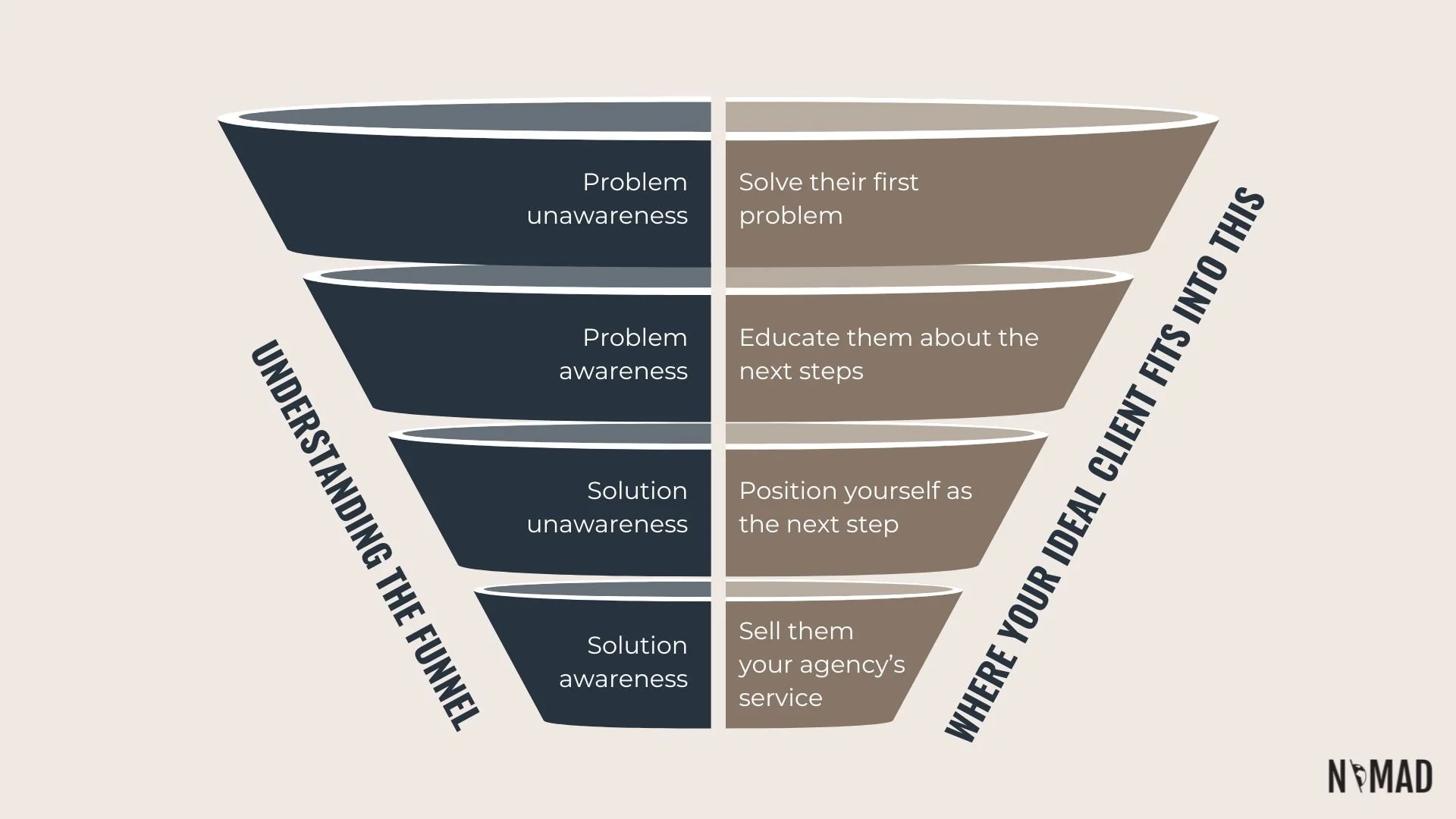
1. ToFu
Top Of Funnel - Someone who just found you. They saw a post or a freebie. This is your introduction moment.
This is your opportunity to make someone problem aware so that you can solve their problems with your solution.
2. MoFu
Middle of Funnel – These are your people who are warming up. You’re introducing yourself, your expertise, and your offers.
You’re taking them from problem aware to solution aware (you are the solution!).
3. BoFu
Bottom of Funnel - These are your people who are ready to become buyers. They’re looking at your sales page, in your DMs with questions, and smashing the buy button.
Each stage needs different content, so think about this when writing your website content (probably MoFu), your ads content (ToFu), or your sales page and checkout page copy (BoFu).
Check out my previous Funnels 101 blog posts and podcasts:
The Catch-All Category: KPI, B2B, ICP, UGC, CTA
A few more that show up everywhere:
1. KPI
Key Performance Indicator – The specific number you're tracking toward a goal. Conversion rate, open rate, podcast downloads, all KPIs.
2. B2B or B2C
Business to Business versus Business to Consumer – A business coach or SaaS is B2B. A potty training coach or personal trainer is B2C.
3. ICP or ICA
Ideal Client Profile or Ideal Client Avatar – The demographic and psychographic picture of your perfect buyer.
4. UGC
User Generated Content – Content made by customers, not your brand. An influencer raving about your product organically counts.
5. CTA
Call to Action – The button or line that tells someone what to do next. Every sales page, email, and video needs one.
Key Takeaways
Marketing jargon is just shorthand that gets repeated until everyone assumes everyone else already knows it. Bookmark this post and come back when you hit a term in the wild and wonder what it means.
If you've got an acronym or marketing term you've been too afraid to ask about, send me a message on Instagram @nomad.copy or email me directly at samantha@nomadcopyagency.com. I'll add it to a future episode.
And if you want a head start on your next email sequence instead of staring at a blank page, grab the Forgotten Launch Emails checklist for $1 with code PODCAST.
Helpful Resources:
Grab the Forgotten Launch Emails checklist for $1 with code PODCAST: https://nomadcopyagency.thrivecart.com/launch-emails-checklist
Grab the Clickable AF CTAs resource here: https://nomadcopyagency.thrivecart.com/clickable-af-ctas/
Connect with me:
Watch episodes with subtitles on my YouTube
See my services → sales pages, emails, websites, and more.
Get on my calendar → if you’d like me to write your sales copy for you!
Opt-In Copy Bot → Write high-converting opt-in pages in minutes
Nomad Copy Agency writes copy that CONVERTS for service-based businesses. Inquire about done-for-you services here.
